
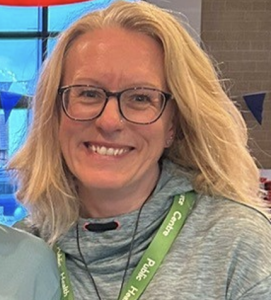
Rachel Dukes
When Rachel Duke joined a leadership programme delivered by the Leadership Centre on behalf of the Office for Health Improvement and Disparities (OHID), she was not actively seeking promotion. Working as an Advanced Health Improvement Specialist at Leeds City Council, she saw the opportunity as a way to invest in her own development at a point when she had the capacity to reflect, following a period of significant personal change.
What she encountered was a programme that challenged not just what she knew, but how she approached her work, offering practical tools alongside a different way of thinking about the complexity of the systems she was part of.
Seeing the system differently
Early in the programme, Rachel was invited to reflect on the public health system. Her response, drawing it as a plate of spaghetti bolognese, was unconventional, but proved to be a powerful way of making sense of the interconnected and often messy nature of the work. “It was quite a wacky illustration,” she reflects, “but it helped me see the complexity in a different way.”
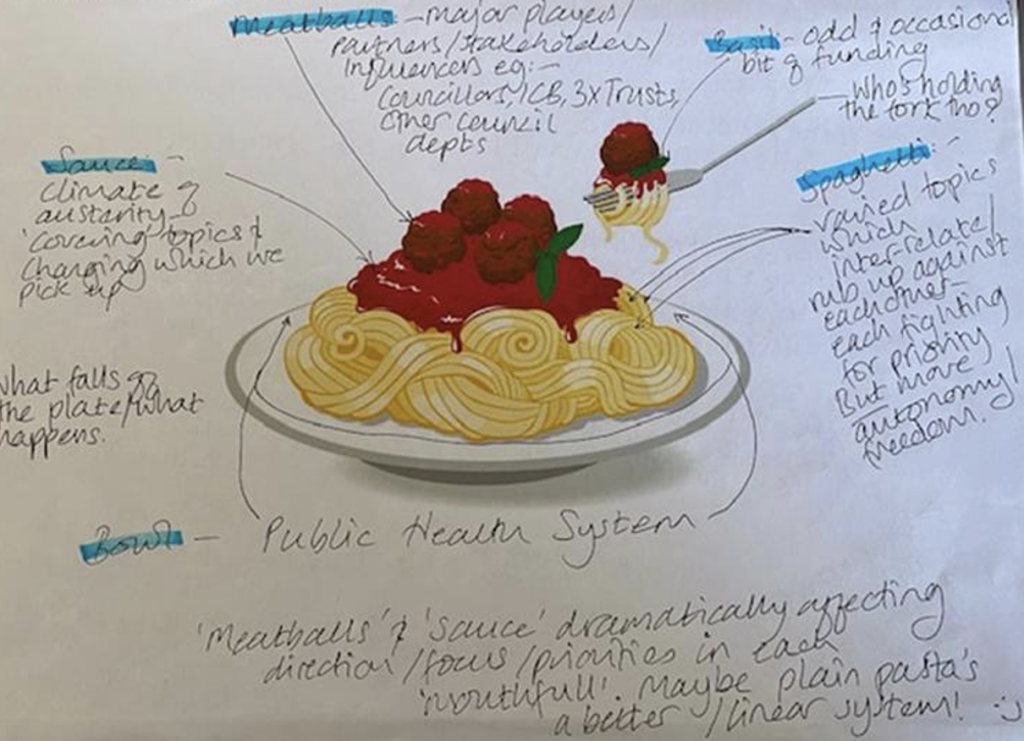 That moment marked a shift in how she approached communication, prompting her to think more visually and more creatively about how to make complex ideas accessible.
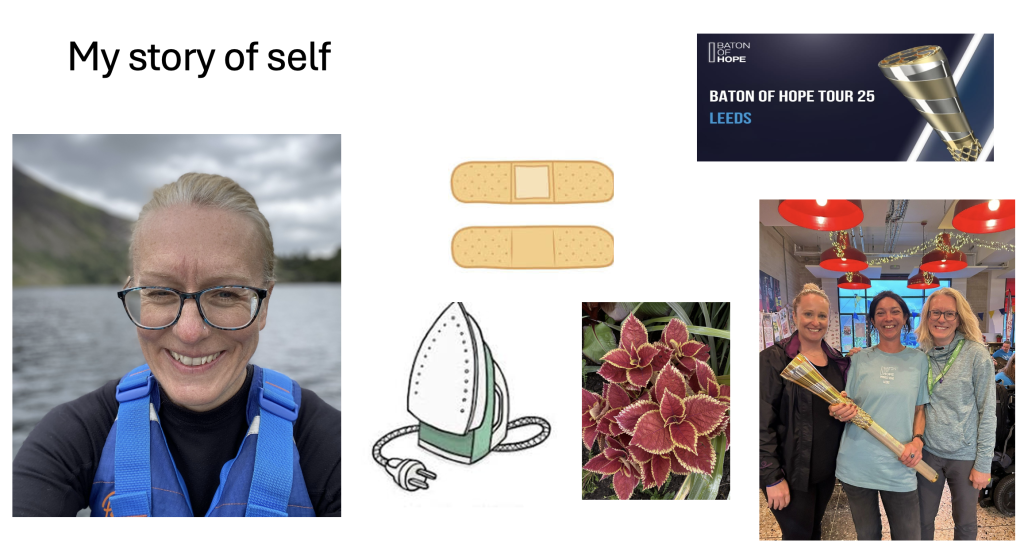
Alongside this, the concept of a “story of self” became an important part of her practice. Rather than beginning with data or direction, it involves sharing something of your own connection to the work, creating space for others to engage in a more open and human way. “I found that when you share something of yourself, people’s guards drop,” she explains. “You become more accessible, and people respond to that.”
Approaching a critical moment differently
Some months later, Rachel applied for a more senior role in public mental health and suicide prevention, a position that attracted a strong field of candidates. In preparing for the interview, she chose to approach it differently, drawing directly on what she had taken from the programme.
Instead of relying on a conventional presentation, she created a series of A3 visual sheets, each bringing together images that represented her thinking. One focused on her personal connection to the work, while others illustrated the tools, assets and approaches she would bring to the role.
Reflecting on her approach, she describes a conscious decision to step away from over-preparation and instead focus on being present in the moment. “I wanted to leave myself in the room,” she says. “Have a good go, and then it’s up to them.”
Opening the interview in this way allowed her to establish a different kind of connection with the panel from the outset. By combining personal narrative with visual representation, she was able to communicate both her perspective and her approach in a way that felt authentic and distinctive.
The feedback she received reflected this. “They said it was a breath of fresh air and that I built rapport with everybody instantly.”
Within 24 hours, she was offered the role.
A shift in how work happens
Reflecting on the experience, Rachel is clear that the impact of the programme was not limited to specific tools or techniques. Instead, it created a broader shift in how she approaches her work and how she makes decisions about where to focus her time and energy.
“In many ways, it wasn’t rocket science, but at the same time, it really was.” she says, describing the learning as straightforward in principle but powerful in practice.
In the context of busy, high-pressure environments, where the tendency is often to prioritise activity over reflection, this shift has been significant. Rachel describes giving herself permission to step back from a cycle of back-to-back meetings, to invest more intentionally in relationships, and to approach challenges with a greater sense of openness.
This has included something as simple, but often overlooked, as making time for more meaningful conversations. “I’ve been giving myself a break,” she explains, “making the time to have a proper chat with someone, rather than just moving from one call or email, to the next.”
Applying learning where it counts
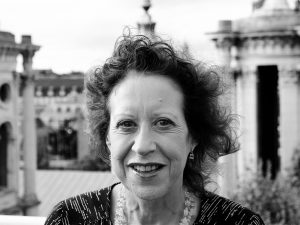
Debbie Sorkin
National Director of Systems Leadership at the Leadership Centre, Debbie Sorkin, facilitated the programme. She explained that the programme was co-designed with OHID and underpinned by a desire to ensure that the learning could be applied directly to the realities participants are navigating every day.
“The challenges facing public health professionals are complex and rarely sit neatly within organisational boundaries, which means leadership is often about influence, relationships and the ability to work across systems, rather than positional authority alone. What matters is creating space for people to experiment with different approaches in live situations, reflect on what happens, and build confidence in their own ability to lead change. Rachel’s experience is a wonderful example of someone taking that learning and applying it in a way that felt practical and authentic to her. We’re pleased that the programme created the environment for that learning to take place in a way which was immediately applicable, and which has contributed to such a positive and successful outcome for Rachel. We’re delighted for her as she steps into this important new role.”
Rachel now moves into her new role as Health Improvement Principal for Public Mental Health and Suicide Prevention, bringing with her not only new tools, but a different way of showing up in the work.
Looking back, she sees a clear connection between the programme and the way she approached that interview, not simply in what she did, but in the confidence and perspective she brought into the room. “I actually really enjoyed the interview,” she reflects. “And I never thought I’d say that.”
Her experience offers a powerful reminder that leadership development is not only about building knowledge, but about creating the conditions in which people feel able to apply that learning in moments that matter.