
Test Valley Borough Council worked with The Leadership Centre to design and deliver a large-scale, organisation-wide leadership development journey at a pivotal moment of place-based ambition and emerging system change. The programme focused on building a common understanding of the community council model in practice, strengthening adaptive and system leadership capability, and equipping leaders at all levels to shape and respond to significant change, including local government reorganisation and devolution, while embedding learning directly into live organisational priorities.
What did the work set out to achieve?
Test Valley Borough Council is justifiably proud to describe itself as a community council: an organisation committed to working with, not doing to, its communities, and to adopting asset-based community development approaches to local public service. Both political and managerial leadership are aligned around this ambition.
By 2024, senior leaders recognised that, while a range of positive initiatives and partnerships were in place, understanding of what being a community council meant in practice was still somewhat uneven across the organisation. There was a desire to move beyond a collection of individual interventions and create a more coherent, shared leadership journey.
The programme therefore set out to build that shared understanding of the community council model and its practical implications, strengthen its adaptive, system and place-based leadership capability, and engage a large cohort of senior leaders in applied learning rooted in real organisational and place challenges. It also aimed to support leaders to prepare for significant future change, including local government reorganisation and the opportunity of devolution.
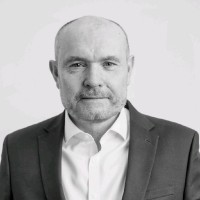
Andy Ferrier
The council’s Chief Executive, Andy Ferrier, was keen to connect leadership development directly to real work, ensuring that learning translated into practical action. He said, “When we commissioned the Leadership Centre, we were in part commissioning them for a future that we felt was going to be financially more unstable. We knew we would need to harness community energy much more if we were going to transform public services, driven in part by the need to reduce financial burdens. But at the same time, it was also a reflection that some of the things we do were created many decades ago and haven’t necessarily transformed that much, but our communities have. In Test Valley we have very different communities – some larger towns, some more rural communities. We shouldn’t be doing the same thing in every place. Every place has its assets, and every place has different assets. So, we do things slightly differently. But in order to get our heads around that, we really needed to start to think differently. And that’s why the engagement with the Leadership Centre was so important to us.”
Who participated?
The programme was phased, starting with a small co-design group then extending to 50 senior leaders (the Senior Management Forum), before extending to a wider group of 90 participants. The final phase of the work engaged the whole organisation – some 500 people.
“It was important to me that we were able to co-design the programme. So, it wasn’t going off to a private sector company that isn’t invested in the sector for them to deliver particular products. It felt like a really great co-design process where we said, ‘this is what we want – how do you think you might deliver it?’ And we ended up with something that, as a result, was innovative and interesting to us.” – Andy Ferrier, Chief Executive, Test Valley Borough Council
Features of the programme
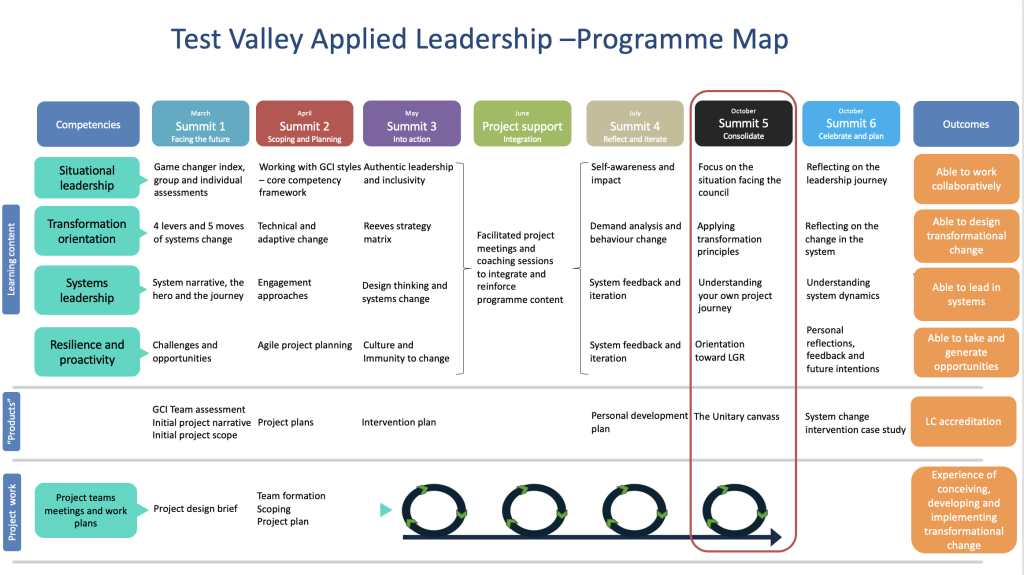
The programme was designed as a connected learning journey that combined large-group summits, project work, and individual and team-based support. It began with a whole-group leadership summit bringing together the full senior management forum to establish the objectives of the programme and to create a compelling shared narrative about becoming a more effective community council. Participants were then supported to identify and shape a set of system and place-based challenges that would help deliver the outcomes the council wanted to see. These projects were explicitly future-facing, providing a practical vehicle for participants to apply new ideas, test approaches and learn through doing. These groups explored themes including digital transformation, ways of working, place-based working, supporting young people, and local government reorganisation, using a shared framework to map where the organisation was starting from, where it aspired to be, and the leadership journey required to move between the two.
Participants were introduced to the Game Changer Index, an organimetric that explores individual and collective tendencies in how people approach change, uncertainty and complexity. Leaders were able to see both their own profiles and the aggregated team profile, offering insight into habitual ways of thinking and operating, and how these patterns might support or constrain progress. This understanding directly informed the themed project work, helping groups design approaches that were better aligned to the type of change they were seeking to create.
The learning journey was structured around a series of six leadership summits which created space for participants to reflect on their project work, explore relevant concepts and frameworks, consider what the learning meant for them as individuals and as a leadership cohort, and identify next actions. You can see the overview of the journey below.
Alongside the summits, the programme built in individual and project-based support. This allowed deeper exploration as well as helping the teams work through obstacles and supporting participants to engage productively with resistance to change. Support between sessions included approaches such as action learning, peer support and other reflective practices.
While underpinned by an integrated theory of change and a set of core concepts, the programme retained a deliberately flexible design. Inputs, exercises and examples were adapted in response to what was happening in the group and the wider environment, balancing structure with responsiveness.
“I’m not going to suggest for a second it’s easy. It’s been hard. The tools and the techniques that the Leadership Centre bring into play are not easy concepts. But when you learnt to ride a bike, you didn’t just get on and do it straightaway. It takes a while, and lots of practice. That sense of moving from a transactional way of working into something that’s truly transformational is not easy. But what we did with the Leadership Centre was we tried to apply it as best as we could. One of the examples is around the way we work in places. We’ve got a long history of working in places, but we really wanted to refine that even more. And as LGR came along at the same time as this work we had space to think and develop some concepts around, for example, doing transformational work with colleagues from the voluntary sector and the NHS. So, as we go into a local government reorganisation process, we’ve got some really interesting strands of work with partners looking at how the future might look different in our places.” – Andy Ferrier, Chief Executive, Test Valley Borough Council
What impact did the programme have?
As the programme progressed, several shifts became visible:
- Stronger shared language around adaptive leadership and systems change
- Greater confidence in working across organisational and professional boundaries
- Deeper understanding of why previous attempts at change may have stalled
- Clearer appreciation of the leadership role in modelling behaviours experienced by teams
Participants also reported greater confidence in acting as leaders of change rather than solely managers of services.
Importantly, learning from the programme fed directly into the next phase of collaborative work associated with emerging local government reorganisation arrangements across the Hampshire and Solent area.
“The work with the Leadership Centre has had a real impact in terms of our outlook on the way things operate. All of our services are now going through their two-year planning process, applying the techniques that we’ve learned with the Leadership Centre. We have lots of great implementers; they get things done, and that’s what public service has been about. Now we know how to create the conditions for them to think slightly differently, as they might just need to do different things in a different way. So we’re applying the techniques that we’ve learned through the Leadership Centre into that service planning process. We’re asking people to imagine themselves in these new unitary authorities. What might it be like? Then we can apply some of the techniques that we’ve learned around adaptive behaviours, which might make a difference for how we do things in the future”. – Andy Ferrier, Chief Executive, Test Valley Borough Council
The Chief Executive reported that in the annual staff survey, staff said for the first time, that a large percentage of people felt managers and leaders in the organisation were conducting themselves in accordance with the values when they were leading and managing their teams. Despite significant uncertainty, the organisation has not seen an increased turnover of staff, which the Chief Executive attributes to creating the space to think differently and imagine the future together.
Reflections
The work illustrates the value of large-scale, applied leadership development that can flex with changing context. With Local Government Re-organisation announced during the programme, it was possible to adapt and shape the learning to new emerging challenges. Rather than being undermined by uncertainty, the approach evolved to support leaders in navigating it, strengthening leadership capability that will remain relevant beyond the life of the programme.
“I really would recommend the Leadership Centre. We knew them before, from being in and around the sector. What I like about them is that they believe in local government, they believe in public service, they have a passion for it. And they want to see things done better. For me, that’s been a driving force. They’ve been able to talk to us about things that perhaps my team wouldn’t be thinking about on a day-to-day basis. So there has been a lot of challenge and that has got to be a good thing. If you go into the programme on the basis that it’s just going to make you all feel better about yourselves, then don’t touch it. But I do personally think that what we’re trying to do here is to progress and move forward. You don’t do that without having people come in and ask you some really difficult questions. So I absolutely would recommend the Leadership Centre.” – Andy Ferrier, Chief Executive, Test Valley Borough Council
If you would like to have a conversation about working with us on your leadership priorities, please drop us an email and we will be in touch: info@leadershipcentre.org.uk